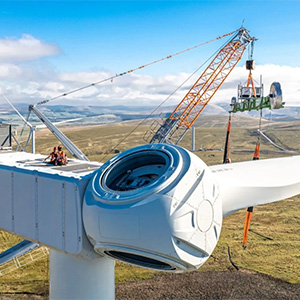
A recap of CEERISK's webinar on fire risk on construction sites: why a live site concentrates fire risk in a way few other environments do, and why the conditions that lead to an incident are often visible well before ignition.
In CEERISK's latest webinar, Fire Risk on Construction Sites, Mamoon Alyah (Managing Director and Principal Engineer), Dr Amir Pourghorban (Senior Engineering Consultant and Head of Scientific Research) and Akhil Raghavan (Engineering Consultant, fire protection) examined a problem that has been familiar to contractors and their insurers for many years.
Using case studies from CEERISK's own investigation work, the session set out to show:
- Why fire risk on a live construction site behaves differently from fire risk in a completed building
- Where the ignition sources and fuel loads actually come from, including the ones nobody plans for
- Why fire protection so often fails to perform when it is needed
Presented by:
 |
|  | ||
|---|---|---|---|---|
Mamoon Alyah | Dr Amir Pourghorban | Akhil Raghavan | ||
| Managing Director, Principal Engineer | Senior Engineering Consultant & Head of Scientific Research | Engineering Consultant |

Why construction sites concentrate fire risk
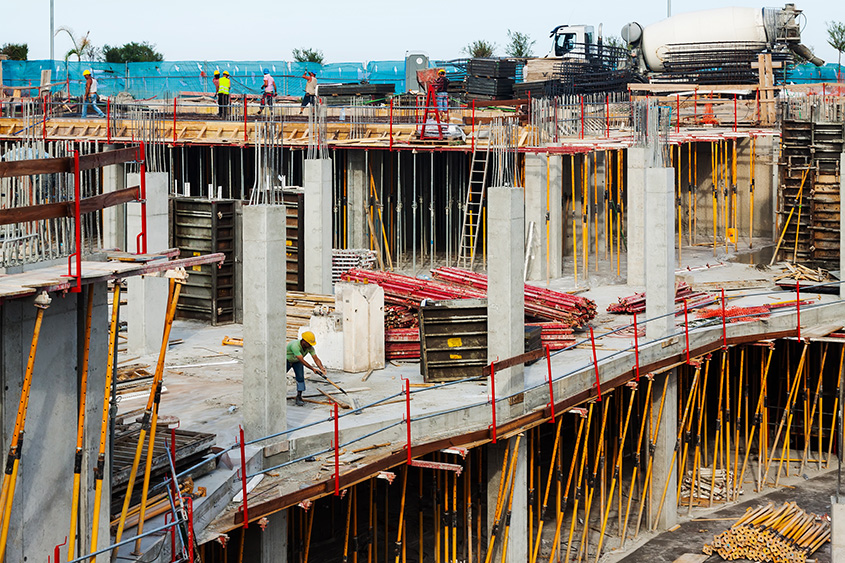 A construction site is a different environment from a residential, commercial or industrial property, and it has to be assessed differently. It changes daily. Ignition sources appear and disappear, fuel loads arrive and accumulate, protection systems are half-built or not yet handed over, and the workforce changes from week to week.
That dynamic quality is the defining feature. A control that is adequate in one month can be inadequate the next without anyone moving anything or making a decision, simply because the site around it has changed. Most of what follows is a consequence of that single fact.
What causes a fire: heat, fuel, oxygen and process
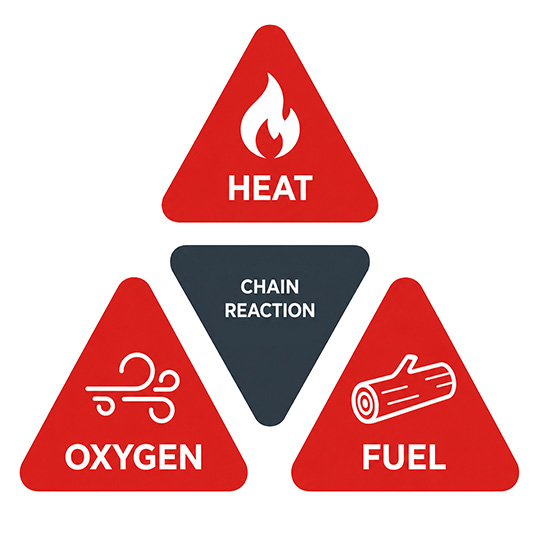 Mamoon opened with the science, and with a deliberate correction to the familiar diagram. A fire requires a heat source, a fuel and an oxidising agent. But those three elements sitting in the same room do not produce a fire, or every room would be alight. What matters is the fourth element in the middle of the triangle: the process that allows a competent heat source to raise a fuel to its ignition temperature in the presence of oxygen.
Competent is the operative word. A heat source is competent only if it generates enough heat to bring nearby combustible material to its ignition point. Ignition alone does not amount to a fire. A fire is a self-sustaining chemical reaction, one that continues to burn after the original heat source is removed.
That process, on a construction site, almost always reduces to a simple equation:
A failure + a human factor = ignition.
Both halves matter, and one of them is frequently the decisive one. Whether assessing a site before an incident or investigating one after, the question covers more than what could burn and what could get hot. It extends to what brought them together.
Case study: a plastics factory in its final weeks of construction
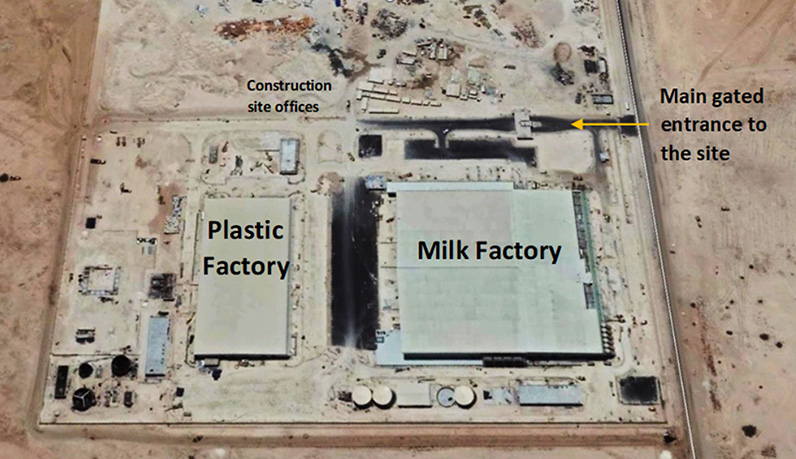
The case, drawn from CEERISK's investigation work in the Middle East, concerned an integrated facility built alongside a large dairy farm. Milk would be brought from the farm to a milk factory for pasteurising and packaging, and rather than buying in containers, the owner had chosen to build a plastics factory next door to produce them. The plastics building was divided into a raw materials store, a machine shop holding a large number of injection moulding machines, and finished-goods warehousing.
The project was in its final stages. The plant had been delivered and was being prepared for commissioning and testing, and the plastic resin pellets had been brought to site for exactly that purpose. The fire occurred in the raw materials store, where those pellets were held in bales and pallets: one of the highest fuel-load areas in the building.
The property damage came to approximately US$25 million, driven by the value of the machinery. The business interruption exposure was worse. A project due for handover within two or three months now had to be cleared and rebuilt.
The first response and why it failed
Early in the morning, with no work underway in the building, someone ran to the security gate shouting that there was a fire. The guard went to the building, looked through a side door and saw a small fire in one corner. Judging it manageable, he went to a nearby fire hose fed from a water tank and turned it on. Nothing came out. The tank was empty. He then went to the temporary fire pumps, started them, found a second hose and returned. Again nothing came out. By that point the fire had reached the plastic pellets in the centre of the store and was growing rapidly. He stepped back and called the fire brigade.
Determining the area of origin
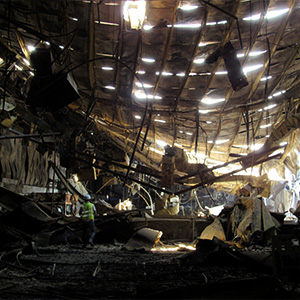
By the time CEERISK attended, the steel beams were essentially all that remained. Sheet metal had been consumed entirely, beams had twisted and collapsed, and burning plastic had released enough energy to vaporise almost everything else. Clearing the site required a substantial workforce on the ground, including cutting through steel beams spanning between sections of the building to gain access.
With the site cleared as far as was practicable, burn patterns and heat damage identified an area of origin near the centre of the store. Within it, CEERISK recovered the remains of an electrical device and associated wiring, which were secured and removed for examination. They proved to be an LED light fitting of a type used throughout the site. Undamaged exemplars elsewhere on the project then confirmed how it had been mounted and wired. Later it was determined that the LED light was the origin of the fire.
Why a 400-watt light fitting caused a total loss
Something did not sit right. A 400 W LED fitting is not, on the face of it, capable of producing a fire on that scale. Examination resolved the question: the fitting was rated for outdoor use only. Asked why it was installed indoors, site personnel explained that it had not been. The fittings had been installed when the warehouse had no roof, and they had simply stayed in place once the building was enclosed.
That is the dynamic-risk problem in a single detail. A fitting that was entirely appropriate one month became inappropriate the next, without anyone moving it or making a decision about it. The risk changed. The installation did not.
Two factors then explained the severity. The first was the fuel load: the bales of plastic pellets sat directly in the area of origin, and once alight they released enormous quantities of heat.
The second was the insulation. The fitting had been mounted directly beneath sandwich panels, which are composite cladding panels built around an insulating core. On examination, that core proved to be combustible. The purchase documentation and data sheets referred to fire testing and compliance, but the panels did not carry the correct certification or rating. Once the insulation caught, the fire spread through the panels, and burning material dropping from above ignited the plastic resin below.
Why the fire protection did not work
Why did neither hose deliver water? The tank the guard went to first was empty. And the fire pump controller was found in the off position, for both automatic and manual operation. No one has been able to explain why. The likely answer is a misunderstanding, either someone assuming automatic operation would still initiate or a decision taken to conserve water. Either way, the guard was pulling out hose reels that were never going to deliver.
Mamoon's own assessment was that, on the facts, the water supply was a secondary factor rather than a primary cause. By the time the guard saw fire in the plastic pellets, the fire had already travelled through the sandwich panels above, and the outcome was probably settled despite his efforts.
How the origin and cause were established
The approach behind the case is the one CEERISK applies to any fire investigation, and it was set out in more detail in the firm's earlier session on investigating warehouse and industrial fires.
Several of its features are visible in this case:
- Origin before cause, and general before specific. The area of origin was established first, from burn patterns, heat damage and the pattern of structural collapse, before any question of ignition source was addressed.
- Safe clearance to reach the evidence. The substantive investigation could not begin until the collapsed structure was cleared, which required cutting steel and an organised workforce. The evidence that matters usually lies beneath the steel rather than in it.
- Comparison against an exemplar. An undamaged fitting of the same type elsewhere on site established how the failed unit had been mounted, wired and supplied. That evidence no longer existed at the origin itself.
- A competent heat source must be demonstrated, not assumed. Electricity is over-attributed as a cause because it is a plausible heat source and an easy conclusion when the evidence has gone. Here the finding held because the mechanism was explained: an unsuitable fitting, energised, mounted directly against a combustible panel core.
- Evidence handled to recognised practice. Artefacts were identified, secured and removed under a chain of custody, in line with ASTM E1188.
Common ignition sources on construction sites
Dr Amir Pourghorban set out the ignition and heat sources CEERISK encounters repeatedly, both in risk assessments and in investigations. Hot work is the source most often named. It is rarely the only one present.
Smoking. Frequently observed on construction sites. The hazard lies in what happens to the cigarette afterwards. Butts are flicked aside, or collected in a plastic bottle or a corner. A smouldering cigarette in the right airflow, adjacent to other combustible material such as other cigarette butts, can sustain itself long enough to ignite.
Hot work. Welding, cutting and grinding all produce open flames, sparks or heat introduced directly into material. An operator may be watching where the sparks land, but a spark can initiate smouldering combustion that develops for a considerable time before any visible flame appears. Rags and combustible materials left resting on steel that has just been cut.
Heavy equipment and machinery. Internal combustion engines run hot, and they bring their own fuel tanks, engine oils and batteries onto the site. Mechanical failure of a machine is, in itself, a credible ignition scenario.
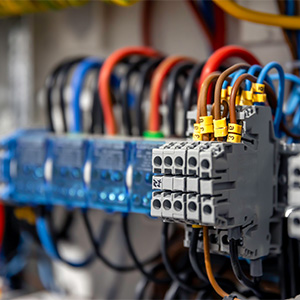
Temporary electrical installations
The category most often overlooked, because unlike hot work it is not visible as an activity. A temporary installation that is designed and installed correctly presents no particular problem. That is what it is for. The difficulty is what happens next:
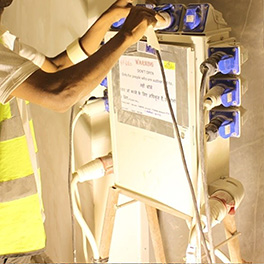 Undocumented modification. Work moves to another floor faster than the electrician can follow, and someone improvises. Was the change agreed with whoever is responsible for the installation? Was it recorded? Frequently, neither.
- Unrated or unsuitable equipment. Heaters used to dry out concrete or plaster, ventilation equipment brought in when it is warm, and lighting installed in basements with no natural light. Where did it come from, is it certified, and has it been checked?
- Damaged cabling. Temporary wiring run across floors and up stairwells will get damaged. A short circuit should trip a protective device, where one is fitted. More dangerous is a damaged conductor that becomes a high-resistance contact, a poor connection that heats up under load rather than tripping anything, sitting against cable insulation and nearby combustibles.
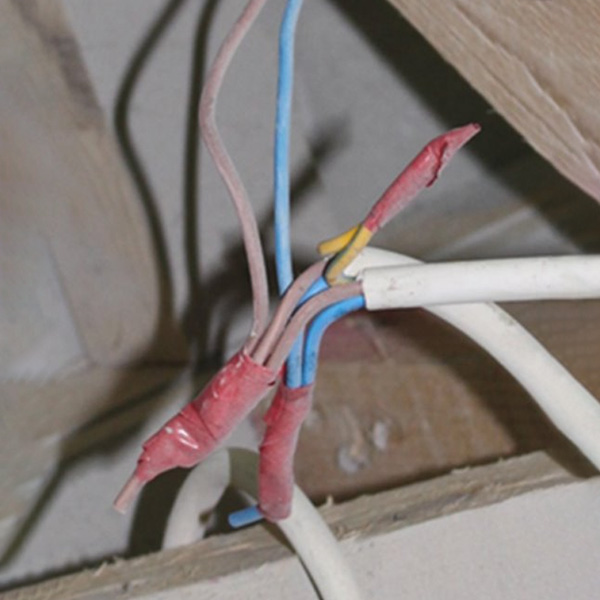 Improper connections. Strip the insulation, twist the conductors, tape it up. It works, until the joint loosens and the contact area reduces, at which point it becomes another high-resistance heat source.
- Overloading. The correct answer to improper joints is proper extensions, plugs and sockets. Those are rated for a specific current. Chaining them together and running beyond that rating is a common finding. A single overload may damage nothing. Repeated over weeks, it degrades the insulation until something fails.
- Poor practice generally. A temporary installation is still an installation. Earthing a circuit to a convenient piece of steel and treating the job as done is not compliance.
Combustible materials and fuel loads on site
Akhil Raghavan set out the corresponding fuel picture. Construction sites naturally accumulate combustible material such as plastic, insulation, timber offcuts, cartons and packaging. It builds up gradually as the project progresses. Even modest quantities matter.
- Gas cylinders. Used for welding and cutting, with specific storage requirements. Damaged cylinders, incorrect storage, or cylinders left connected after use are serious hazards. Disconnect after the activity and keep them away from heat sources.
- Paints, solvents, adhesives and thinners. The critical point is that it is usually not the liquid that burns but the vapour coming off the container. Keep containers closed after use, hold only the quantities required, and keep them away from hot work areas.
- Equipment fuels. Forklifts, generators and heavy plant bring petrol, diesel and hydraulic oil onto the site. Regular inspection for fuel and oil leaks, and designated parking and storage areas, are basic controls.
- Waste. Accumulates rapidly, adds directly to the fire load, and obstructs both escape and firefighting access. Regular housekeeping is the control, and it has to be enforced rather than assumed.
- Packaging and shipping materials. Wooden pallets, cartons and plastic wrapping are left on site because someone expects them to be collected later. They ignite readily.
- How material is stored, not just what. In many investigations the placement of the material has mattered more than the material itself: stacked against the building, blocking access routes, too close to a hot work area, or too close to a ceiling or wall. Separation from ignition sources is frequently among the more effective controls available on site.
Why fire protection underperforms on construction sites
Mamoon closed by looking at protection underperformance on construction sites, and the fire safety challenges that recur across them.
Extinguishers are misunderstood. Fire extinguishers exist primarily to allow people to escape, which is why they are positioned by exit doors. They are not there so that occupants can advance into a fire. On a permanent property, the location map and inspection record are straightforward to maintain. On a construction site it is close to impossible to know whether extinguishers are where they should be, whether they are charged, whether they have been discharged, or whether they are being used as door stops.
There is no compartmentation. Compartmentation is the division of a building into fire-resisting compartments, so that a fire is contained where it starts. It is one of the last things to be completed. Fire doors are not hung, ceiling penetrations for cables and pipework are unsealed, and protection to structure is incomplete. A small fire in one part of the building can spread aggressively across it.
Access and space are constrained. Mamoon described a large Middle East site where a worker installing architectural features in a ceiling faced a half-hour climb down the scaffolding and half an hour back up if he wanted to smoke. He decided to skip the hassle and smoke where he was. When someone approached, he panicked and dropped the cigarette through an opening left for a light fitting. Smoke appeared shortly afterwards, and nobody could reach the seat of the fire. On congested urban sites, limited space also makes waste accumulation effectively unavoidable when clearance is not frequent.
Water supply. On remote sites, water arrives by tanker and is held in temporary tanks. Water reserved for fire protection is not always available, and it is not always monitored once it is there.
Detection and alarms. Detection on construction sites is limited, and where smoke detectors are installed, dust triggers them repeatedly. Panels get silenced, and often nobody on site knows why or by whom. Fire watch personnel are frequently absent on very large sites.
Those are conditions a surveyor can see on a walkthrough. The problems that follow are harder to observe, because they sit in the arrangements between the parties on site rather than in the fabric of the building.
The sign-off gap. This finding carries particular weight, and it recurs. A fire protection contractor completes commissioning and testing and asks the owner or main contractor to sign off. The response is that sign-off will follow when everything else on the project is complete. The contractor, unwilling to carry liability or start a warranty period without it, shuts the system down. From that point, everyone on site might believe there is a working fire protection system, when there is not.
Compliance is a recurring failure. A subcontractor improvised an addition to a temporary distribution panel. It was installed because there were no spare outlets, at the wrong rating, and directly beneath a sign instructing him to call the responsible person. He did not call because he was rushed and expected no timely response. Mamoon's observation is that the gap widens at the end of a project, when deadlines bite hardest and the value at risk on site is at its highest.
Coordination and enforcement. On a site with 15,000 workers a day and around 140 subcontractors, organising everyone so that each party knows what to do is a substantial undertaking. Smaller subcontractors, engaged by a tenant rather than the main project, arrive with a narrow window to complete their work and limited interest in the wider site regime. One site had twelve languages spoken across its workforce, which made English-language safety signage largely ineffective.
Fire brigade access. For remote sites and high-rise projects, a risk assessment should establish whether the nearest fire station has appliances and ladders capable of reaching the building at its designed height.
Key takeaways for construction fire risk
Construction sites cannot be assessed like completed buildings. They are dynamic. Ignition sources come and go, fuel loads arrive and accumulate, and the protective measures assumed to be in place are frequently incomplete, disabled or not yet handed over. Managing that requires enforcement rather than documentation alone. As Mamoon noted, the volumes of procedure produced during a risk assessment rarely match what an investigation finds afterwards.
Two themes ran through the session.
The decisive detail is usually small, and visible beforehand. A light fitting that stayed where it was when the roof went on. A panel whose core was not what the paperwork said. A controller left in the off position.
The same detail decides what follows. Cause, contribution, compliance, liability and recovery all turn on it. Identifying it, and being able to support the conclusion under scrutiny if the matter is disputed, is what a thorough forensic investigation provides.
The work spans CEERISK's services: risk management to assess fire risk and protection on a live project before an incident occurs, forensic engineering to investigate it afterwards, and expert witness and expert advice where it escalates.
Related sessions: Investigating Warehouse and Industrial Fires and Battery Fires: Cause, Risk & Evidence.
Working on a construction site fire or a live project risk?
If you would like to discuss how the approaches covered in the webinar might apply to a current matter, we would be glad to talk it through.