A recap of CEERISK’s webinar on how forensic engineers establish the origin and cause of large warehouse and industrial fires, and why the cause is rarely where the damage looks worst.
In CEERISK’s latest Emerging Trends Webinar, Investigation of Warehouse & Industrial Fires, Mamoon Alyah (Managing Director and Senior Engineer) and Akhil Raghavan (Forensic Engineer and Fire Specialist) worked through one of the most persistent challenges in forensic engineering: determining how a large warehouse or industrial fire started when the fire itself has destroyed much of the evidence.
It is a topic CEERISK has returned to almost every year since the firm began running these sessions, because warehouse fires remain a significant and recurring problem for insurers, insureds, brokers and risk owners across many regions. Using two anonymised case studies drawn from CEERISK’s own work, the session set out to show:
- Why large warehouse and industrial fires are uniquely difficult to investigate
- How origin and cause are established when the obvious evidence has largely gone
- What those findings mean for coverage, warranties, liability and subrogation
Presented by:
 |  | |
| Mamoon Alyah Managing Director at CEERISK Consulting | Akhil Raghavan Forensic Engineer and Fire Specialist |
Why warehouse fires are so hard to investigate
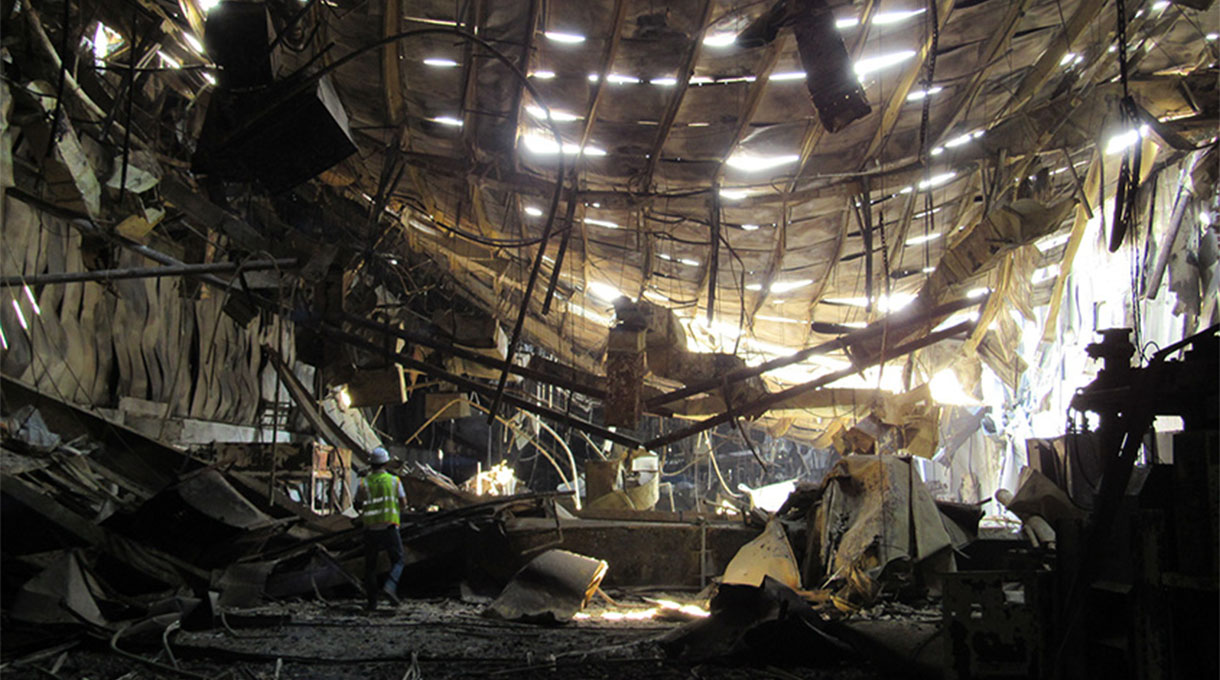
A textbook fire investigation begins with reading fire patterns: the soot, the burn signatures on walls and ceilings, the way damage radiates from a seat of fire. In a fully developed warehouse fire, that approach is close to unusable.
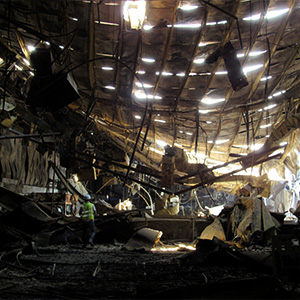
Warehouses are large, open spaces with high fuel loads. When the fire is severe enough to collapse the roof, the most telling patterns are often consumed or buried, and the scene is frequently disturbed further by firefighting and emergency debris removal before any investigator arrives. Where a warehouse has burned to that extent, the delicate fire patterns are often no longer there to read.
So the investigator widens the evidence base. Burn patterns are not only soot on a wall. The heat experienced by steel structures, the degree and direction of structural collapse, corrosion and discolouration on beams, the fuel load and the chemistry all carry information. A heavily twisted beam, a column that is still standing straight, the direction a roof fell: each is a tell-tale. A section that shows little damage and an intact roof, for example, suggests there was not enough fuel there to sustain a prolonged fire, and collapse in that section may have been mechanical, caused by an adjacent unit failing, rather than driven by heat from within. Reading those structural signatures, alongside witness accounts, CCTV, records and a careful electrical examination, is how the origin is determined when the fire patterns alone cannot provide it.
How a fire investigation actually works
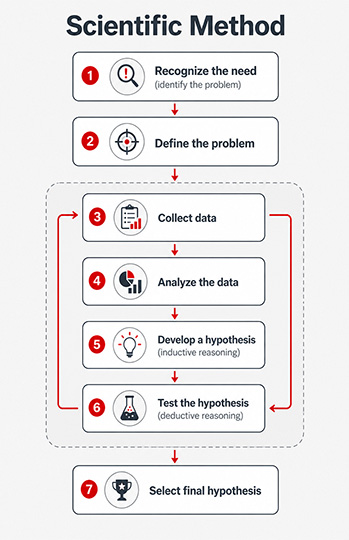
Between the two case studies, Mamoon set out the method that sits beneath any credible fire investigation. It is, by design, multidisciplinary. It draws on engineering and the sciences (fire science, chemistry, thermodynamics, electricity, fluid mechanics and metallurgy), on legal questions (liability, the rules of evidence, expert reporting), on insurance (coverage, warranties, property and liability) and on investigation technique (interviewing, analysis and research). It also follows recognised guidance, notably NFPA 921, the Guide for Fire and Explosion Investigations, rather than the investigator’s intuition.
NFPA 921, the Guide for Fire and Explosion Investigations
Determining the origin
Origin determination moves from the general to the specific: from the area of origin (the broad location where the fire began) to the point of origin (the precise spot). It draws on fire patterns and the physical remains, and in warehouse fires it leans heavily on the structural tell-tales described above when the patterns themselves are gone.
A collapsed roof must be cleared carefully, because partial collapses are especially hazardous: what is stable and what is not cannot be assumed. But the steel of the roof is rarely the point. The investigator is interested in what burned and what could have generated the heat to start the fire, which is the contents beneath. Clearing the structure safely to reach that evidence is the point at which the substantive investigation can begin.
Witnesses and the timeline
Witness accounts are valuable, but they are perceptions recorded under stress, not facts. Studies by the NFPA, universities and law-enforcement bodies have shown that people escaping a fire remember what they perceived, not precise measurements or exact times. A witness statement becomes a fact only when it is corroborated: by physical evidence, by other witnesses, and by records.
The timeline is built the same way. People do not check their watches as a fire develops, and their sense of how quickly the brigade arrived, for instance, can differ sharply from the dispatch log. So each entry in the timeline is validated against a record: fire-service dispatch and arrival times, police records, fire-alarm or building-management-system logs, and CCTV. One important caveat applies here. CCTV clocks must be confirmed as correctly synchronised, a frequent trap where clocks have not been updated for seasonal time changes. Every point on the timeline is paired with the source that evidences it.
Determining the cause: the fire triangle and the “how”
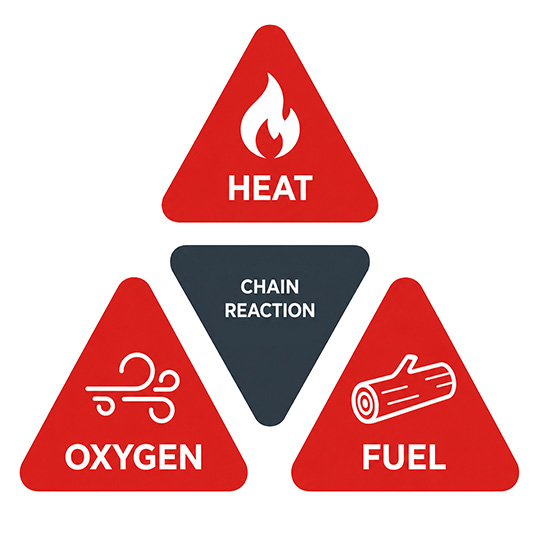 Cause is the how question. Fire needs heat, fuel and oxygen, but the decisive element is the process that brings the three together. Look around any room and you will find abundant heat sources and abundant fuel, yet no fire. What causes ignition is the specific circumstance that raises a fuel to its ignition temperature. That does not happen by accident in the loose sense. Something always leads to it.
Electricity deserves particular care, because it is over-attributed as a cause. It is an easy conclusion to reach when the evidence has disappeared, and it is a plausible heat source. But a credible finding has to explain the mechanism. For electricity to cause a fire, the item must first be energised, and it must then generate sufficient heat to raise the temperature of nearby fuel to its ignition point. Energised alone is not enough, and generating some heat is not enough.
And warehouses carry more electrical energy than is often assumed. CEERISK has seen fires linked to faulty light fittings, particularly the high-intensity discharge (HID) lamps common in warehouses, where a protective cover is sometimes not refitted after relamping. The LED fittings increasingly replacing them perform far better, but they are not inherently fire-proof: their control units generate heat and must be correctly rated and tested. Wiring and stored appliances add to the load.
Identifying the fuel follows the same logic in two parts: the first fuel ignited, meaning what sat closest to the heat source, and then how the fire spread through the secondary fuels in the building. And a warehouse is not always only storage. CEERISK has repeatedly found units quietly converted into workshops with hot works underway, or into light manufacturing. From an insurance standpoint that is a change to the risk profile, and where it has not been disclosed, it is a significant problem.
Evidence, testing and the legal discipline
A fire investigator is not only an engineer. They must understand the legal weight of the evidence. Collecting and preserving it to recognised practice (ASTM E1188 and ASTM E2332) means tagging suspect and potential artefacts, documenting their condition, producing an inventory, photographing thoroughly and removing items only after a chain of custody is established.
Testing can be decisive: visual and dimensional examination, microscopic and mechanical evaluation, electrical and chemical analysis, bench simulation and component-failure reconstruction. But it is expensive and not always proportionate. The investigator has to judge what each test will actually establish. Running an exemplar test to prove that a fire can occur, for instance, adds little when the task is to investigate one that already has.
Classifying the cause and assigning responsibility
A fire’s cause is ultimately classified as one of four: accidental, natural (such as lightning), incendiary (deliberate), or undetermined. Undetermined is a legitimate and honest finding when the evidence is no longer there to support a firmer conclusion. From there, responsibility resolves to either an action, meaning something done, whether intentionally or accidentally, or an omission, a failure to act that led to the fire.
Case study one: a multi-tenant warehouse complex
The first case, presented by Akhil, concerned a multi-tenant warehouse complex in the Middle East. It comprised five interconnected units beneath a shared roof structure, steel frame with metal-sheet roofing and common boundary walls. The units held mixed occupancies under different tenants: automotive parts, electrical appliances, plastic products and wooden furniture.
The fire broke out late one evening in 2025, affecting three of the units and causing significant structural damage and substantial contents loss. The complex was secured and unoccupied at the time, with no operational processes or heat-producing activities underway.
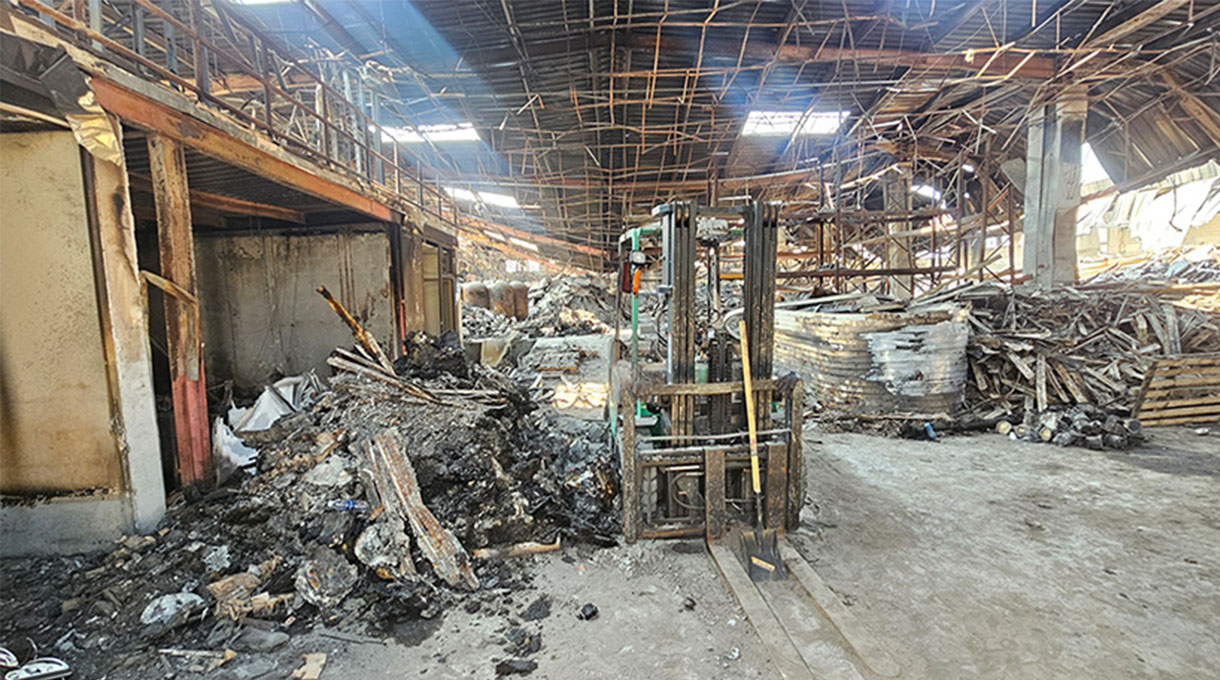
CEERISK’s investigation combined a walkthrough inspection of the affected areas, photographic documentation, examination of the electrical systems and stored equipment, assessment of potential ignition sources and fire-spread pathways, examination of the fire protection systems, and witness interviews.
The damage gradient pointed the way. The three units had not burned equally. One unit had sustained extensive roof collapse and near-total destruction of contents. An adjacent unit had lost most of its contents but retained much of its roof structure. A third unit showed the most severe damage of all: burn-through of the roof sheeting, structural collapse and the greatest contents destruction in the complex. That concentration of severity identified the third unit as the probable area of origin.
The other evidence agreed. Witnesses reported seeing smoke first emerging from the mid-section of that unit, and mobile video captured smoke rising from its roof. CCTV added a precise sequence: external lighting was illuminated normally, then began flickering intermittently before a lighting outage at roughly 21:16, with the first visible smoke appearing on camera at around 21:24 from the area of the two worst-affected units. The CCTV and the witness accounts were consistent with one another, and both pointed to the same area of origin.
A power outage had been reported at the complex earlier in the evening, a damaged overhead utility conductor adjacent to the premises was noted, and the lighting circuits remained energised in the period before the fire was detected. Assembling each event against its evidentiary source (witness reports, the CCTV clock and the utility complaint record) produced a defensible chronology rather than a narrative resting on memory alone.
What could not be determined. Extensive debris had been removed before CEERISK’s inspection, leaving only structural remains and a significantly disturbed scene. A specific point of origin could not be established. This is an honest and common outcome in large warehouse fires, and the investigation reported it as such rather than overstating.
After assessing the credible ignition sources (distribution boxes, the utility supply and warehouse distribution, and the stored electrical appliances), and finding no evidence of deliberate ignition and no operational processes in use, CEERISK concluded that the most likely cause was an electrical fault involving ceiling-mounted lighting and its associated wiring within the area of origin. Combustible stored materials then drove rapid fire growth, and an open connection between two of the units permitted lateral spread between them.
For the insurer, those findings matter on several fronts. They locate the origin, rule out a deliberate act, and identify the probable mechanism.
Case study two: when the gaps go unbridged
The second case, presented by Mamoon, illustrates why the warranties and exclusions in a policy can matter as much as the origin and cause themselves.
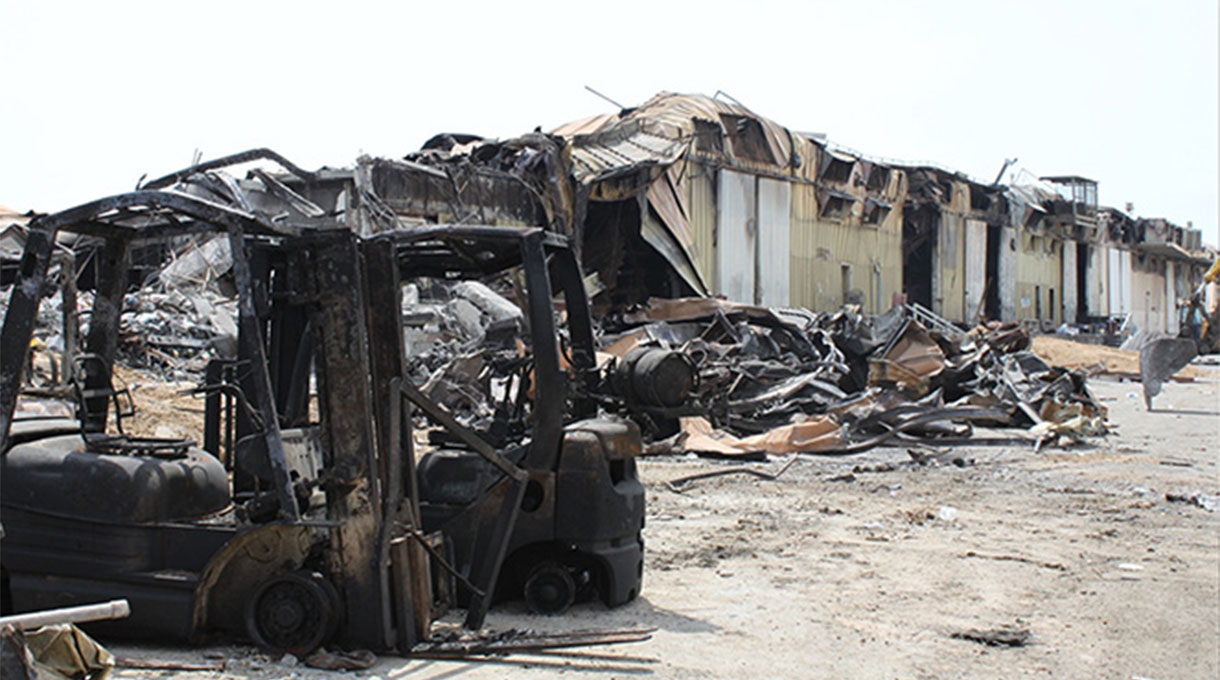
The property was a large multi-unit distribution and manufacturing complex in the Middle East, roughly 40,000 m² divided into around seven units, storing food and edible oils, including large cold stores. It sat close to critical infrastructure, including substantial fuel-storage tanks.
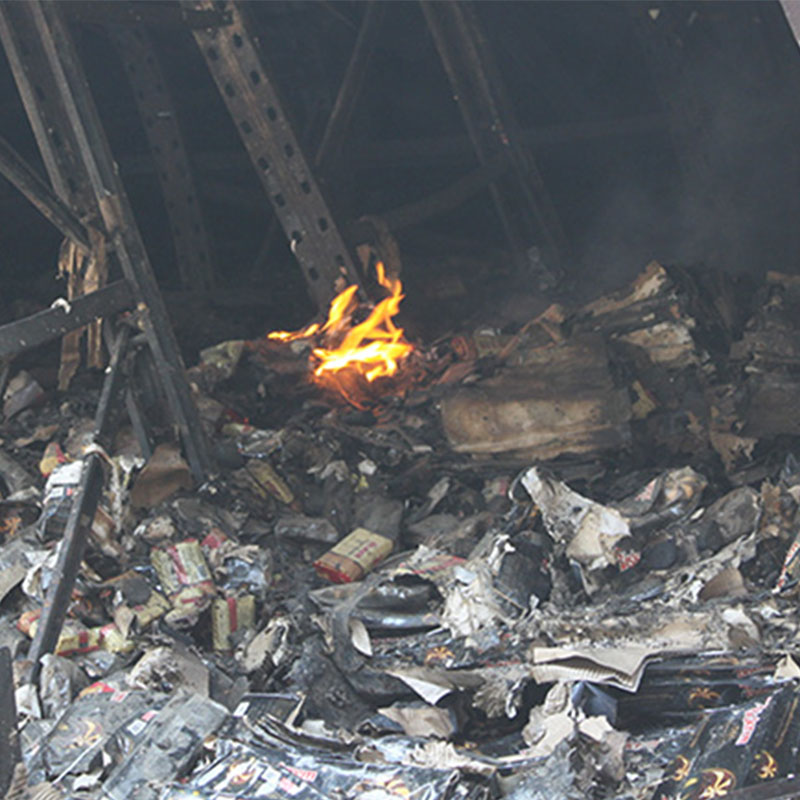 The firefighting strategy shaped the loss. A site guard noticed the fire while it was still small, photographed it and called the fire service immediately. But the responders had to position their resources to stop the fire reaching the nearby fuel tanks, unquestionably the right call, which meant other units were not directly defended. One unit, its owner reported, burned in full after hours without intervention. The fire then refused to go out, and it kept rekindling for roughly 28 days, with crews repeatedly suppressing flare-ups.
The fuel load explained both. Edible and vegetable oils, once alight in an open area, tend to burn until they are consumed, and they are extremely difficult to extinguish. After a roof collapse there is ample oxygen and concentrated heat to keep them burning. The fuel load, in other words, governed how the fire behaved, how long it lasted and the limits of what suppression could achieve. It also, after that much burning, made fire-pattern analysis effectively impossible.
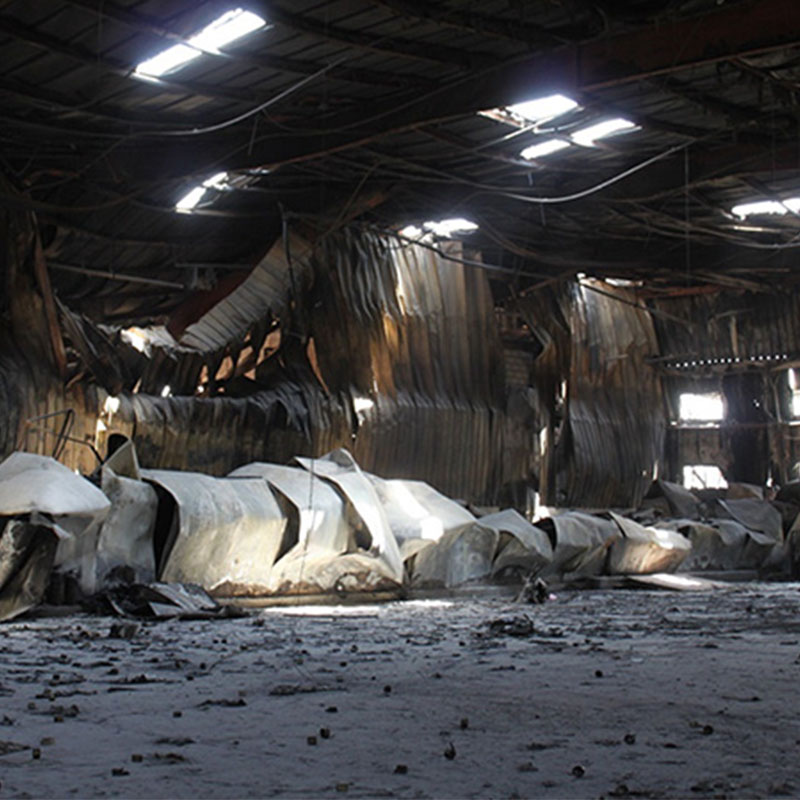 The origin was found through other evidence. The fire had started in the one section that had not collapsed: a large cold store. Recent electrical work had been carried out on a rear wall, and a fault in the associated switch or control box had ignited the insulation, with the fire spreading from there. That conclusion was reconstructed not from burn patterns but from the guard’s photograph, civil-defence footage and first-responder accounts of what they saw on arrival.
Then the warranty question: did the protection work? The fire pumps were present, tested and certified by a third party and the civil defence, with no performance issue. The sprinklers had triggered, but they had not controlled the fire. Pipework and connections were found broken, but on examination, the breakage was an effect of the building’s collapse, not a pre-existing cause. Distinguishing cause from effect there was critical, because it would have been easy, and wrong, to record the broken pipes as the reason the system failed.
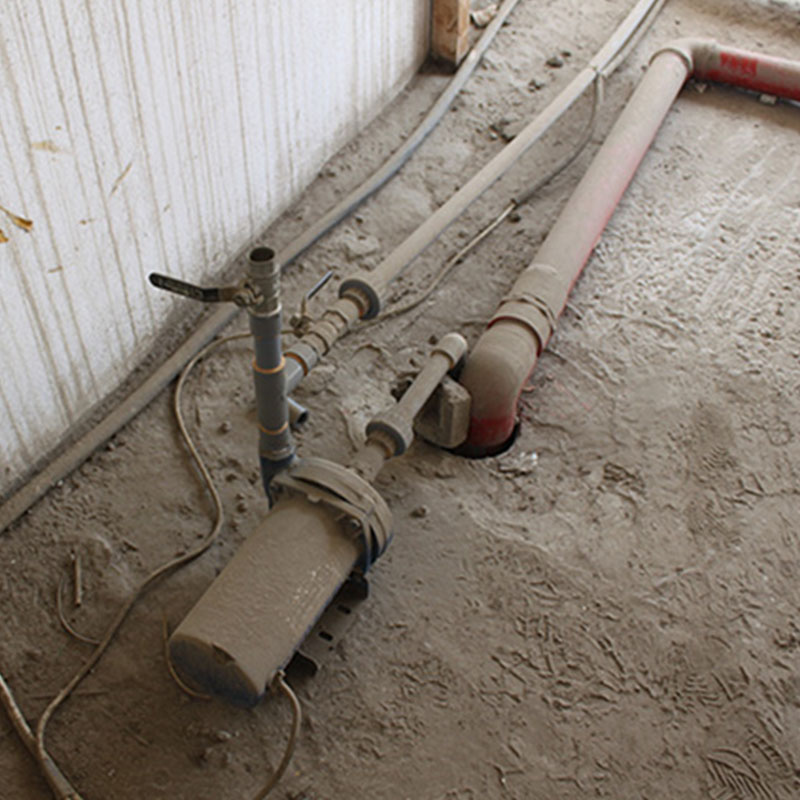 The actual problem was the water supply. The tank was depleted, and the investigation found a small, unauthorised pump that a guard had installed to run an informal car-washing business, drawing from the main supply tank. A faulty float meant the tank was not refilling automatically, so there was insufficient water for the sprinklers to perform, even though the pumps worked and the sprinklers had operated.
The lesson is twofold. First, that answer existed in no single burn pattern and no single record, and it had to be pieced together from the whole evidence picture. Second, an otherwise-compliant fire protection system was defeated by a tiny, undisclosed, informal modification. That is the kind of gap on which warranties and exclusions turn, and the kind of detail a thorough forensic investigation exists to uncover.
What the session set out to demonstrate
For insurers, reinsurers, brokers, loss adjusters, lawyers and corporate risk owners, the practical message is straightforward. Large warehouse fires defeat the textbook approach, because the destruction is too complete, the fuel loads too high and the scenes too disturbed. A defensible finding therefore comes from integrating structural evidence, validated witness testimony, records, CCTV and a careful electrical examination, all handled to recognised standards.
Two themes ran through both cases. The cause is rarely where the damage looks worst. And the decisive factor is often small, undisclosed or counter-intuitive: an informal pump that emptied a sprinkler tank, an open connection that let fire pass between units, a relamped fitting missing its cover. Identifying those factors, and being able to support the conclusion if a claim or dispute follows, is what a thorough forensic investigation provides.
That work spans CEERISK’s services: forensic engineering to investigate the loss, expert and expert-witness services where it becomes a dispute, risk management to assess fire protection and occupancy risk before a loss occurs, and data sciences to support the analysis.
Working on a warehouse or industrial fire loss?
If you would like to discuss how the approaches covered in the webinar might apply to a current matter, we would be glad to talk it through.